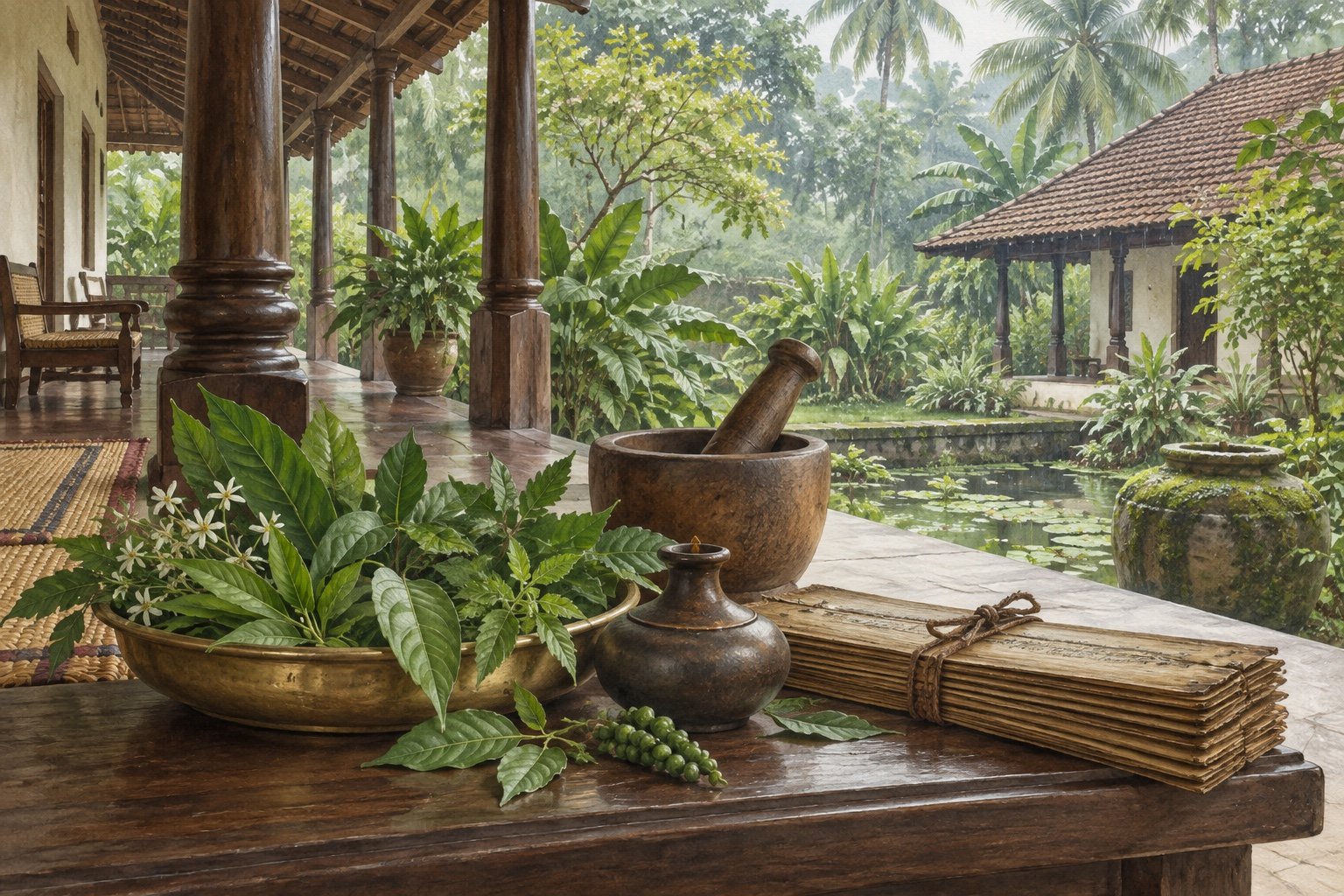
In Kerala, Ayurveda belongs to a familiar cultural landscape: the physician’s consulting room, medicinal plants in a courtyard, the smell of prepared oils and the attention given to food when the rains arrive. Its story is larger than a spa treatment. It brings together medical literature, practical training, family traditions and ideas about how people live through changing seasons.
Ayurveda means knowledge of life. This article explores its history, Kerala’s contribution, its relationship with Jyothisha and the natural materials and routines associated with its practice. It also distinguishes traditional explanations from benefits established through clinical research.
Ayurveda and Jyothisha: a shared heritage, distinct disciplines
Ayurveda and Jyothisha are often discussed together because both belong to India’s wider intellectual and cultural traditions. However, calling Ayurveda a branch of Jyothisha is not an accurate general classification. Ayurveda is traditionally described as an Upaveda, while Jyothisha is one of the Vedangas.
Their purposes differ. Ayurveda developed as a medical tradition concerned with health, illness and care. Early Vedanga Jyothisha addressed the calendar and the timing of rituals through observations and calculations involving heavenly bodies. Their shared concern with time helps explain why the two appear together in conversations about traditional life.
The calendar can provide cultural context for seasonal observances. It cannot diagnose an illness or establish whether a medicine is suitable. A horoscope should never determine a prescription or delay necessary treatment. Readers can appreciate the historical relationship while keeping medical decisions with qualified healthcare professionals.
From early traditions to medical literature
Indian traditions connect Ayurveda with the Vedas, particularly the Rigveda and Atharvaveda. Its literature developed over a long period through teaching, compilation and revision. It is more accurate to describe this as an evolving tradition than to assign every present-day practice a single ancient date.
The Charaka Samhita and Sushruta Samhita are major works in this medical heritage. They preserve discussions of the body, illness, examination, medicines and treatment. The surgical material associated with the Sushruta tradition also reminds us that Ayurveda’s history extends beyond herbs and oil massage.
The Ashtanga Hridaya, associated with Vagbhata, became especially influential in Kerala. Such works helped organise learning and gave successive generations of physicians a shared vocabulary. Their transmission involved explanation and practice as well as memorising verses.
Dhanvantari and the cultural memory of healing
Dhanvantari holds a special place in Ayurveda’s religious imagination. Traditional accounts describe the transmission of medical knowledge through divine figures and sages. These stories express gratitude for healing and respect for the physician’s responsibility; they are religious narratives rather than independently dated medical history.
This distinction allows readers to value a tradition without confusing different kinds of knowledge. A prayer before treatment can carry personal meaning. The suitability of the treatment still depends on the patient, the practitioner’s assessment and the available evidence.
Why Kerala became an important centre
Kerala’s Ayurvedic heritage grew through the interaction of Sanskrit medical learning, regional practices and knowledge of local medicinal plants. The Ashtavaidya tradition is especially important. Its name refers to learning across Ayurveda’s eight classical branches, rather than to eight identical treatments.
The Ashtanga Hridaya provided an important textual foundation for these physicians. Learning also depended on close training and the practical skills needed to identify ingredients, prepare medicines and observe patients. Kerala’s contribution lies in this combination of literary scholarship and hands-on care.
The region’s plant life supported a rich materia medica, but a plant’s local availability does not make every preparation suitable for everyone. Correct identification, preparation and quality are essential. Respecting this knowledge means recognising the skill involved, rather than treating every garden herb as a ready-made remedy.
From household traditions to institutions
Kerala’s more recent history includes the growth of institutions that brought treatment, teaching, publishing and medicine preparation together. P. S. Varier founded Arya Vaidya Sala at Kottakkal in 1902. Its history illustrates how an inherited tradition could develop an organised public presence.
The Aryavaidya Patasala began at Calicut in 1917. Teaching institutions helped carry medical learning beyond a purely household setting. They also made written study and structured training increasingly visible parts of Kerala’s Ayurvedic identity.
These developments are a useful reminder that tradition has never meant standing still. The way knowledge is taught, medicines are prepared and patients reach a physician can change while a community continues to value its older literature and practices.
How Ayurveda describes the person
Ayurveda’s traditional framework includes the three doshas: Vata, Pitta and Kapha. They organise ideas about movement, transformation and stability in the body. Prakriti refers to constitution within this framework, while agni is used in explanations of digestion and transformation.
These are concepts within a traditional medical system. They should not be presented as direct equivalents of hormones, blood tests or modern laboratory measurements. A short online questionnaire cannot replace a consultation or establish the cause of symptoms.
Ayurvedic assessment traditionally considers the person’s history and present condition. Discussions can include appetite, digestion, sleep, daily activity and the course of an illness. The emphasis on individual circumstances is one reason a responsible treatment plan should not simply copy another person’s prescription.
Food, daily routine and seasonal care
Dinacharya concerns daily routine, and ritucharya concerns adjustments associated with the seasons. These ideas encourage attention to how a person eats, rests and lives in a particular environment. They place everyday habits within the conversation about health.
Their practical value begins with observation. A person might record changes in sleep, meals, activity and symptoms, then discuss those patterns during a consultation. Such a record can make the conversation more useful without turning ordinary changes into a self-diagnosis.
Individual circumstances matter when changing a diet. An elderly person, a child, a pregnant woman and someone taking regular medicines may have different needs. A traditional food preparation should therefore be considered in the context of the person’s existing care, rather than as a universal solution.
Karkidakam and Kerala’s monsoon customs
Karkidakam, the last month of the Malayalam calendar, generally falls in July and August. In Kerala it is associated with seasonal care, changes in food habits and periods devoted to rest and religious observance. Ayurvedic treatment during this season remains a well-known cultural practice.
The tradition reflects attention to the effect of seasonal change on everyday life. However, the idea that a particular calendar month makes every treatment more effective should be understood as a traditional belief, not a universal clinical finding. A patient’s condition and the suitability of care remain more important than the date.
Someone living outside Kerala should also consider local weather. A Malayalam calendar month does not create Kerala’s monsoon in Australia or another country. Seasonal customs can be appreciated thoughtfully while treatment decisions respond to the place and circumstances in which a person actually lives.
Understanding familiar Kerala treatments
Abhyanga is an oil application and massage practice. Shirodhara involves a controlled flow of liquid over the forehead. Pizhichil combines the application of warm prepared oil with coordinated manual treatment. These names describe different procedures, not interchangeable versions of a single massage.
Njavarakizhi uses cloth bundles containing specially prepared rice in a supervised treatment. Other kizhi procedures use different materials. The ingredient, temperature, pressure and duration all matter, which is why a photograph or treatment name cannot tell a reader whether a procedure is appropriate for them.
Panchakarma refers to a group of specialised procedures within Ayurveda. It should not be understood as a compulsory cleansing routine for healthy people or attempted from online instructions. An attractive wellness package is not a substitute for an individual clinical assessment.
Benefits: separate comfort, tradition and clinical evidence
People may value a course of care for the attention given to their routines, the opportunity to rest and the experience of supportive treatment. These experiences matter, but they do not by themselves prove that a particular medicine cures an illness.
Research on massage suggests possible short-term relief for some pain conditions, although the strength of the evidence varies. Findings about massage in general cannot automatically be transferred to every Ayurvedic oil or Kerala procedure. A benefit needs to be judged for the specific treatment and condition being studied.
Some studies of Ayurvedic interventions have reported benefits, but many are small or have methodological limitations. Evidence remains insufficient for many advertised uses. It is therefore better to discuss a specific goal, such as improving comfort or function, than to promise a cure for all diseases.
What natural treatment should mean in practice
Ayurvedic preparations may contain plant ingredients, and some also contain minerals or metals. Natural origin does not guarantee safety. Product quality, the dose and possible interactions with other medicines matter; some preparations have contained harmful amounts of lead, mercury or arsenic.
Tell your healthcare professionals about every medicine and supplement you use. Do not stop prescribed treatment or postpone assessment because a product is described as traditional. Children, pregnant people and those with ongoing conditions need individual advice before using preparations or undertaking intensive procedures.
For readers, the most useful questions are straightforward: What is being offered? What is the intended benefit? What evidence supports it? What are the possible harms? Clear answers make it easier to respect tradition while making an informed decision.
Visiting an Ayurvedic centre thoughtfully
Ask who will assess you, what their qualifications are and who will perform the procedures. Discuss your health history and current treatment before purchasing a package. Ask for the proposed plan, ingredient details, follow-up arrangements and costs in writing.
Distinguish a relaxation service from medical treatment. If a centre offers to treat a diagnosed condition, ask how progress will be assessed and when another clinician should be involved. A responsible explanation should leave room for questions and recognise the limits of what is being offered.
A living heritage worth understanding
Ayurveda’s place in Kerala cannot be reduced to an advertisement for rejuvenation. Its history includes texts, teachers, skilled preparation, institutions and household customs. Its continuing appeal also reflects a wish to give food, rest and the rhythms of daily life more thoughtful attention.
Understanding that heritage does not require treating every traditional claim as proven. It calls for curiosity about the past, care with the meaning of medical words and honest discussion of benefits and limitations. This is how cultural appreciation and informed healthcare can sit comfortably together.
This article provides historical and general educational information. OlaMatch’s astrology reports do not provide medical diagnosis or treatment advice. Consult a qualified healthcare professional for personal medical decisions.